An Italian diptych in the Liège collections
An Italian diptych in the Liège collections
Gaddi Diptych
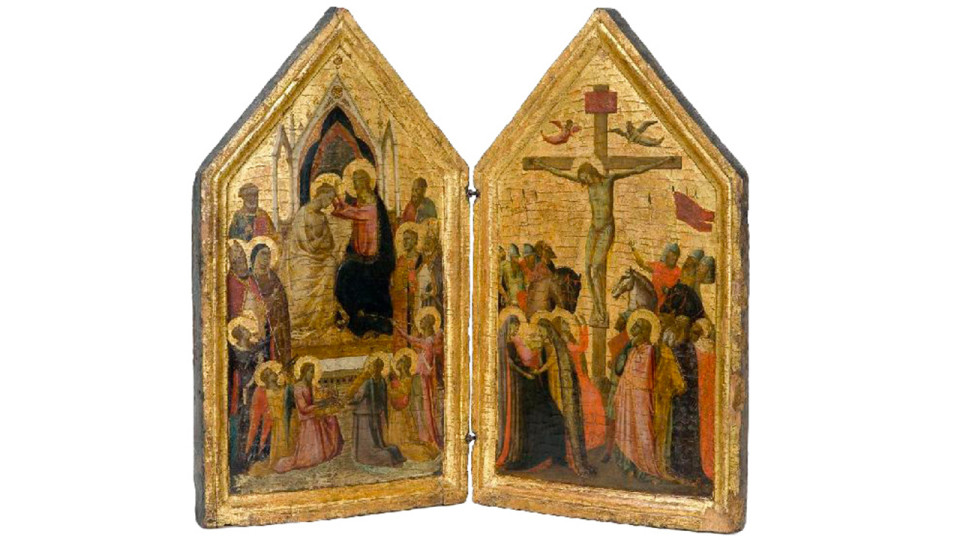
Attributed to Taddeo Gaddi (1333–1396) – Florentine School of the Trecento c. 1350
The Coronation of the Virgin and The Calvary
Tempera and gilding on poplar panel
Department of Religious Art and Meuse Art
Inv. A1/1913
This small Italian diptych is one of the earliest works to enter the collections of the former Museum of Religious Art and Meuse Art, of which the Department of Religious Art and Meuse Art is partly the successor. It has been held there since 1911, following a bequest from Father Scheen, who had himself inherited the collection from his friend Jules Helbig, one of the founders of the Diocesan Museum.
Designed as an object of private devotion, this diptych could be folded shut and easily transported, particularly whilst travelling. In terms of its technique, style and exclusively religious iconography, it follows in the tradition of Italian Trecento painting, from the 14th century. Its style bears similarities to that of the Florentine painter Taddeo Gaddi, one of Giotto’s most talented pupils. The work is, however, attributed to the master’s circle rather than to Gaddi himself.
The painting remains deeply influenced by the tradition of Byzantine icons. The faces, with their highly stylised features, are expressionless and stand out against a uniform gold background. This golden light, like the haloes surrounding the heads of the figures and angels, helps to create a sacred and timeless atmosphere.
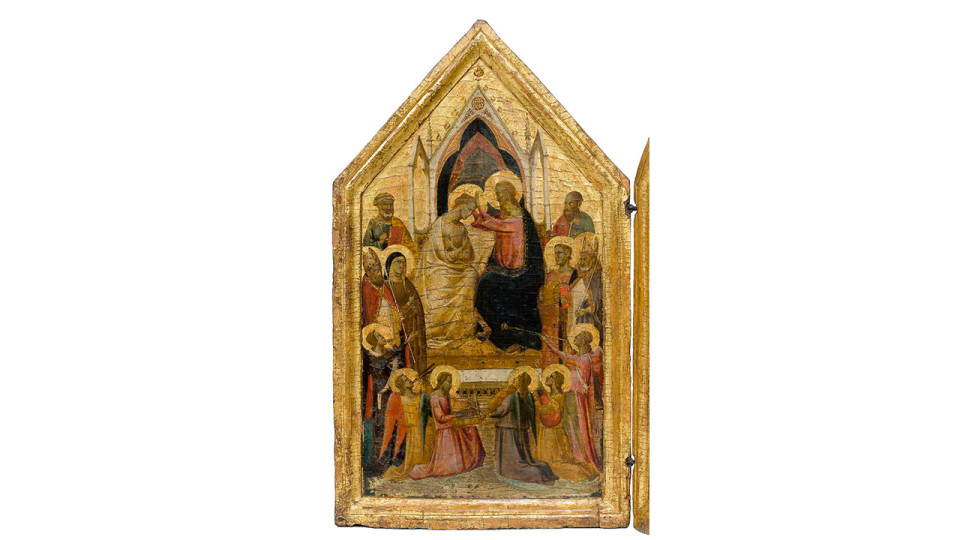
On the left-hand panel, the Virgin is crowned by Christ beneath an openwork Gothic canopy. Mary is depicted seated, a common pose in 13th- and 14th-century depictions of the Coronation of the Virgin.
Several saints are depicted around the heavenly couple: Saint Peter, top left, and Saint Paul, top right. In the lower register are two bishops with halos, followed by Saint Catherine of Siena and Saint Catherine of Alexandria, recognisable by the wheel associated with her martyrdom.
Six angelic musicians occupy the lower part of the scene. They play various instruments — flute, organ, lute, trumpet and bagpipes — lending the depiction a particularly solemn and festive air.
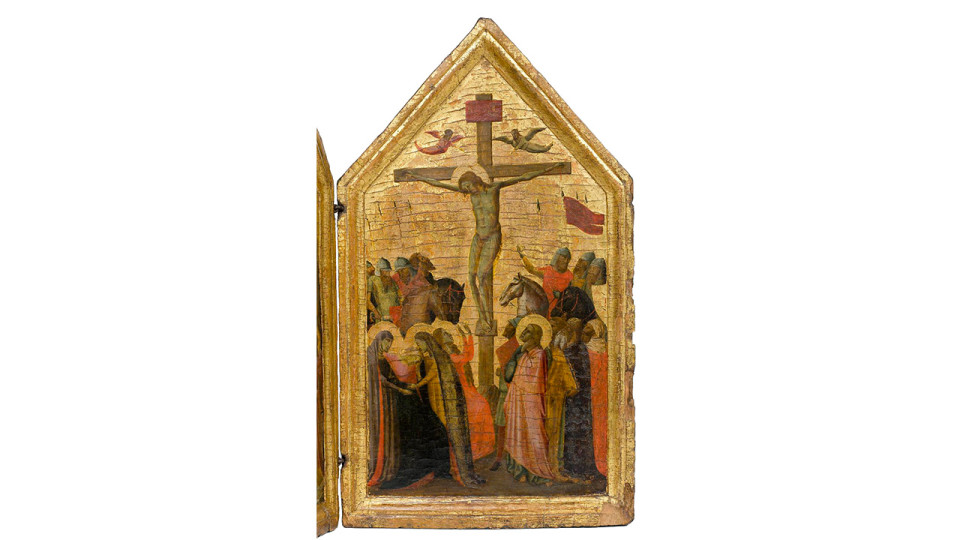
The right-hand panel depicts the Crucifixion of Christ. The scene shows a large crowd gathered around Calvary, in a style that became common in late medieval art. To the left of the cross, the holy women, Mary of Cleophas and Mary Salome, support the weeping Virgin Mary.
On the right stand Saint John, Joseph of Arimathea and several onlookers.
Saint John is the only apostle present at the foot of the cross. Christian tradition explains the absence of the other disciples by the fact that they fled following Christ’s arrest; some had betrayed or denied him, whilst others had simply abandoned their master.
In the background, armed horsemen are part of the scene. Christ, his eyes closed, is nailed to a cross surmounted by a titulus bearing the inscription ‘ID JC’. Small angels flit around him in the sky. His feet, crossed over one another, rest on a suppedaneum, a small shelf attached to the cross.
From the 13th century onwards, the depiction of Christ crucified on three nails became widespread in the West: the two feet were then superimposed and secured by a single nail. Christ with his eyes closed also became a characteristic motif of Italian painting of this period, whilst this style appeared earlier in the northern schools.
The diptych is painted on a poplar wood panel, a type of wood very commonly used by Italian painters in the Middle Ages. A linen canvas was first applied to the wood, then covered with a layer of gesso. This smooth, white layer served as the ground for the paint and the gilding.
The background and frames of the panels are gilded with gold leaf on a red bolus. This fine preparation, made from orange-coloured earth, makes the gold easier to polish and gives it a warm tone. The haloes are finely incised to create a striped pattern. Other gold decorations adorn the clothing and a few objects.
The painting is executed in tempera, a technique characterised by the application of small coloured hatches. In the flesh tones, one can see the use of a dark undercoat known as verdaccio, which was characteristic of the Italian technique of the period. The surface layers of pink and white have become more transparent over time, but they have also been worn away by aggressive cleaning. Today, the flesh tones appear more greenish than they should.
Audrey Jeghers
Curator – Restorer / Museums of the City of Liège
Exhibition location
The objects are on display in the ‘Object of the Month’ showcase. Entrance hall of the Grand Curtius Museum in Liège.
Photo copyright: City of Liège – Grand Curtius