RESTORATION OF LEATHER ITEMS FROM THE STUDY OF EUGÈNE YSAŸE

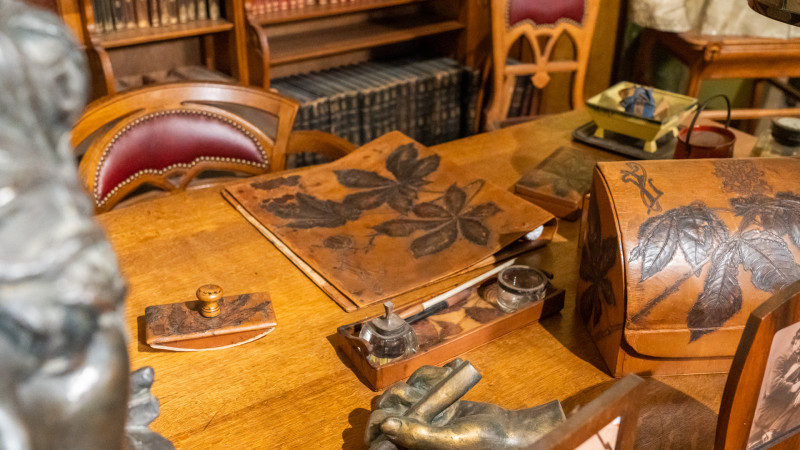
It was in 1894 that the famous violinist and composer from Liège Eugène Ysaÿe (1858-1931) had a house built in Brussels on Avenue Brugmann. For the occasion, he commissioned an entirely furnished workspace from his friend, architect Gustave Serrurier-Bovy. This unique testimony to the encounter between two renowned artists of the late 19th century is now part of the City of Liège’s collections, thanks to a donation by Eugène Ysaÿe’s heirs.

Virtuous Spa water and its bottles

Spa’s springs were already known to the 1st-century AD Latin scholar and author Pliny the Elder but were rediscovered in the middle of the 16th century by Gilbert Fusch, who was a German-born physician and a member of the court of Liège. In 1559, he published a work written in Latin and translated into several languages, under the title “The acidic fountains in the Ardennes Forest and chiefly the one in Spa”. Discover the object of the month for March 2024.

A model of an altar for the Sainte Croix collegiate church in Liège

In 1847, the sculptor was commissioned by the Sainte Croix church administration board to create new sculptures for the building, which was in the process of being restored. In 1849, he presented a model of the altar of Saint Hubert, which was to be made at a later date. The centre of this lavish altar was intended to house, like jewel box, the statue of the saint, surrounded by reliefs depicting the key points in his life.

Art deco in full colour: the Schneider glassworks

Charles shaped his talent in the burgeoning period of Art Nouveau: he took lessons at the Fine Arts Academy while working, from 1902 for the Daum studio. This glassworks’ economic and artistic boom also coincided with the presence of the Schneider brothers. Charles designed models of vases while Ernest held an administrative position. A change of management at Daum led to the departure of many employees. Ernest was let go in 1911 with a substantial severance payment and Charles also left the firm.

A pair of nautiluses that raise questions

In 1910, thanks to a large donation made by Miss Sophie Moxhon (including more than 2,500 objects), this astonishing pair of nautilus cups was added to the collections at the Grand Curtius. The shell’s surface was polished to a mother-of-pearl finish using a grinder or acid and then was carefully engraved with a décor of fantastical characters (sphinx, Terminus, etc.), scrolls, flowers, animals and horns of plenty.

The Queen Elisabeth Medal

In May 2020, the Grand Curtius is Highlighting this medal portraying Queen Elisabeth, originally intended, during the World War I, to reward anyone who has devoted a year to war reliefs. The medal, with a red cross under the ribbon, was intended especially for health care workers and nurses whose quiet devotion and sacrifice greatly helped to ease the suffering of many sick and wounded.