A ‘speaking’ bust
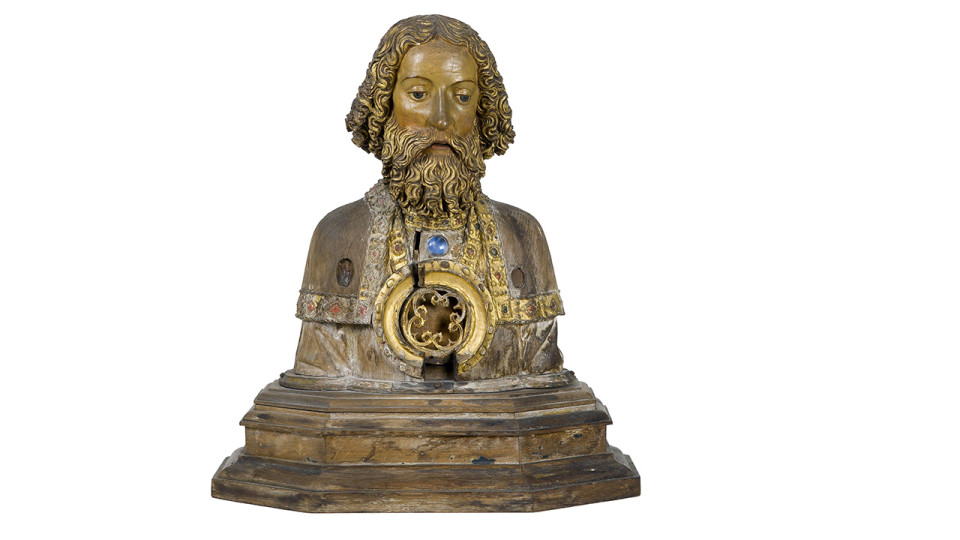
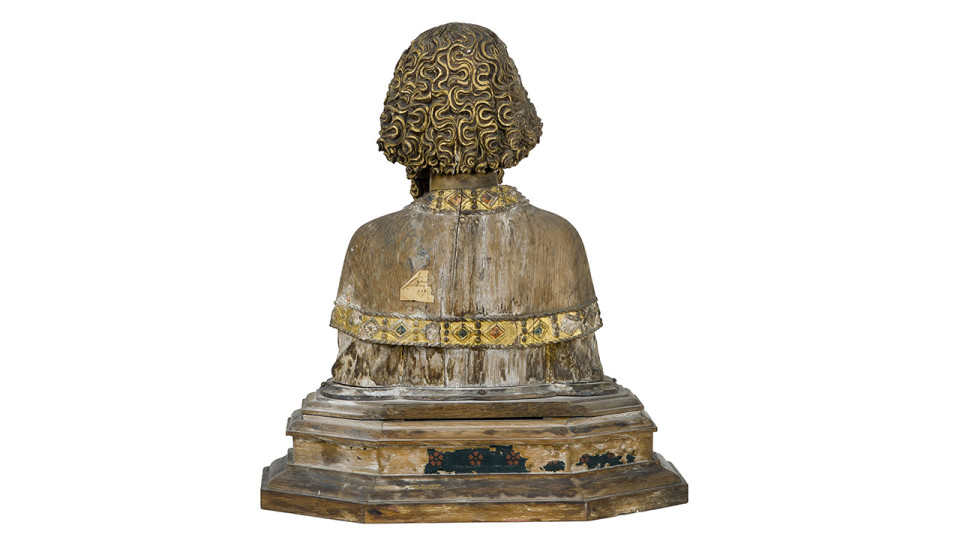
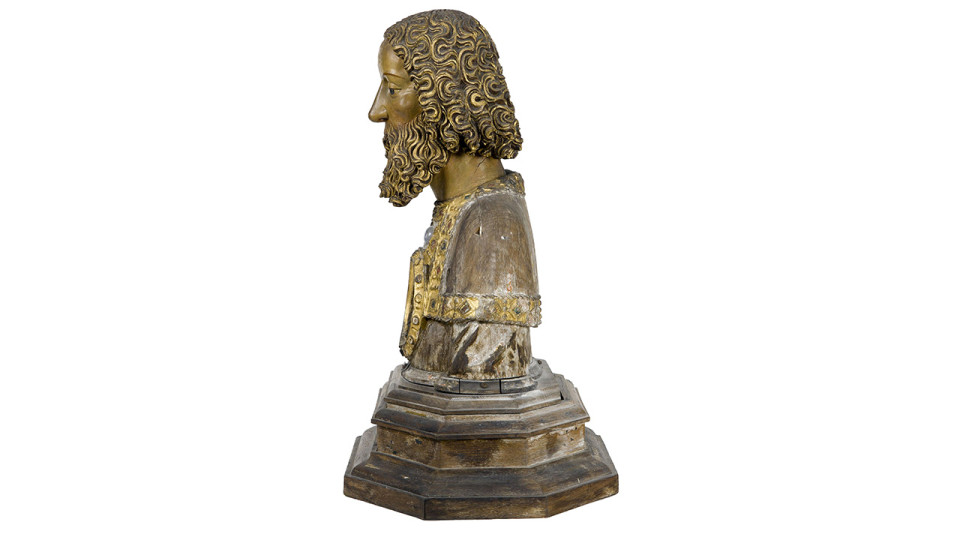
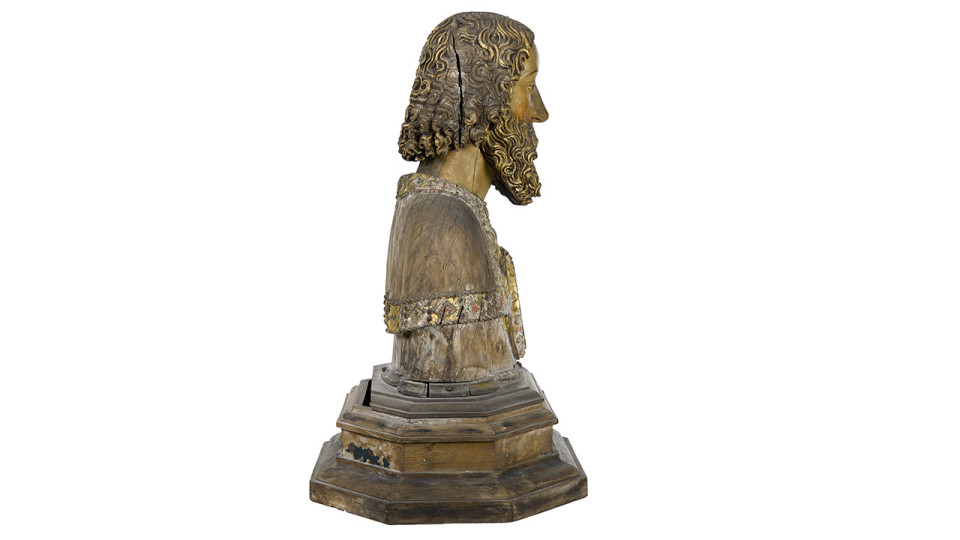
Follower of Jan van Steffeswert.
Reliquary bust of Saint Bartholomew.
Limburg, c. 1520–1545.
Carved oak, recent polychromy.
Later base.
Inventory numbers: C 36; GC.REL.02b.1937.30507.
Dimensions: with plinth: H. 61.8 cm x W. 55 cm x D. 35 cm; without plinth: H. 48.4 cm x W. 33.3 cm x D. 19 cm.
Department of Religious Art and Meuse Art – on loan from the Society of Art and History of the Diocese of Liège.
Saint Bartholomew
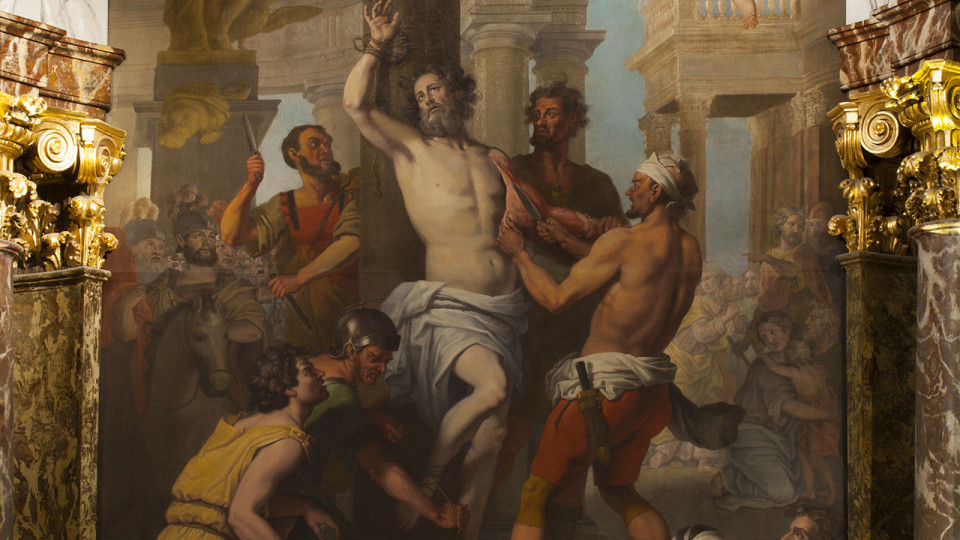
Saint Bartholomew was one of Jesus’ apostles, sent to preach the Gospel in the eastern regions, including India and Armenia. His martyrdom was brutal: he was flayed alive or, according to some accounts, even crucified upside down and beheaded.
This is why he is often depicted with a knife (the instrument of his martyrdom) or wearing his own skin. There are some magnificent examples of this, including, in Liège, the remarkable painting of the Martyrdom of Saint Bartholomew, displayed on the high altar of Saint Bartholomew’s Church. The Liège painter Englebert Fisen (1655–1733) succeeded in conveying all the dramatic tension of the torture in this work.
A reliquary bust of Saint Bartholomew
Reliquaries come in a wide variety of forms: caskets, pendants, crosses and even pouches. This ‘speaking’ or ‘morphological’ (or ‘anatomical’) reliquary bust belongs to a highly original and explicit category in which the container takes the form of the human remains that constitute the relic. One therefore finds head-reliquaries, arm-reliquaries, foot-reliquaries, hand-reliquaries, finger-reliquaries and even rib-reliquaries or jaw-reliquaries.
This bust of Saint Bartholomew comes from Zepperen (Sint-Truiden) in the province of Belgian Limburg. It entered the department’s collections in 1910 through Joseph Scheen, parish priest of Wonck, a collector and great lover of heritage.
Although bust-shaped reliquaries became popular in the Middle Ages, the Renaissance and subsequent centuries also reserved a prominent place for them.
Enhanced with gilded relief ornamentation, the museum’s piece bears traces of former cabochons, of which only a single rock crystal example remains. Worn as a long pendant, a circular medallion opens via a window onto the reliquary compartment, now empty of its contents.
The undulating hair and beard, and the slightly parted lips are all expressive features that contribute to the embodiment of this saint, whose relics were venerated.
A document dated 11 May 1529 was housed within the bust; it stated that this copy replaced an older one and that it contained the relics of Saint Bartholomew’s head. Nothing remains of it now.
Most of the saint’s body is preserved on Tiber Island in Rome (Italy). Other relics are kept in Benevento (Italy), Laon (France), Frankfurt (Germany) and Maastricht (Netherlands).
An attempt at attribution
From the early 20th century, the work has been attributed to Jan van Steffeswert (c. 1460–c. 1530), a sculptor active in Maastricht and originally from Stevensweert (the Dutch province of Limburg). He is also known by various forms of his name: Jan van Steffenswert, Jan van Stevensweert, Jan Bieldesnider or Jan van Weerd,
It was also suggested that he might be associated with the output of a German workshop in the Kleve district (Kreis Kleve), in Lower Rhine (Germany).
Today, it is generally attributed to a Limburg artist from the school of Jan van Steffesweert, or at the very least to an artist influenced by his style. The manner in which the curls of the hair and the strands of the beard are rendered is reminiscent of the master’s work, whilst the rendering of the face and eyes is more distinct from his style.
Christelle Schoonbroodt
Curator of the Department of Religious Art and Mosan Art
Exhibition location
The objects are on display in the ‘Object of the Month’ showcase. Entrance hall of the Grand Curtius Museum in Liège.
Photo copyright:
- ©KIK-IRPA, Bruxelles, numéros de photos X012518 à X012521 - https://balat.kikirpa.be/object/10009998
- Englebert Fisen (Liège,1655 - Liège, 1733), Le Martyre de saint Barthélemy, huile sur toile, 1707 - ©KIK-IRPA, Bruxelles, numéro de photo X069186 - https://balat.kikirpa.be/object/10108778