POMORAMA | Architectural Post-Modernism in Liège
A preliminary survey of Liège’s post-modernism
Whilst the architecture of the first half of the 20th century has gradually gained international heritage recognition since the 1990s – a sign of the ongoing broadening of the concept of heritage that began after the Second World War – recognition of more recent architectural movements remains marginal. This observation is all the more compelling when it comes to post-modernist works. Characterised by a diversity of critical responses aimed at moving beyond modernism, post-modernist architecture – referred to in Anglo-Saxon critical vocabulary by the abbreviation ‘Po-Mo’ – emerged in Italy and the United States before spreading internationally between the 1960s and 1980s. In Belgium, this architectural shift took hold from the 1970s onwards and left its mark on Liège’s urban landscape right up to the turn of the 21st century.
Given the scale and diversity of Liège’s post-modernist built heritage, the “Patrimoine(s): Questions contemporaines” seminar at the Faculty of Architecture of the University of Liège has, together with its students and in collaboration with the City of Liège, undertaken an initial retrospective examination of this as yet poorly documented heritage by drawing up the beginnings of a critical inventory.
Available free of charge online in the form of an interactive map, POMORAMA – a panorama of post-modernist architecture – invites visitors to explore this still little-known aspect of the recent architectural history of Liège city centre.
POMORAMA: A reflection on Liège’s post-modernism
Conceived as a critical retrospective, the exhibition “POMORAMA, Architectural Post-Modernism in Liège” examines the memory and conservation challenges of post-modern architecture in Liège. The exhibition brings archival documents into dialogue with photographs by Mathias Elaerts, which explore the shifting nature of post-modernism over time. It also features Amandine Guitoun’s “Po-Mo” and “Sparadraps” collections of objects, revisiting the aesthetic codes of this period.
Partners
An exhibition organised in collaboration with numerous partners who, through the loan of works and documents and their support, have made this exhibition possible.
Practical information
> Grand Curtius Glass Gallery – Féronstrée 136 – 4000 Liège
> 3–27 September 2026
> Free admission
Image copyright
- 1st image: M. Coq
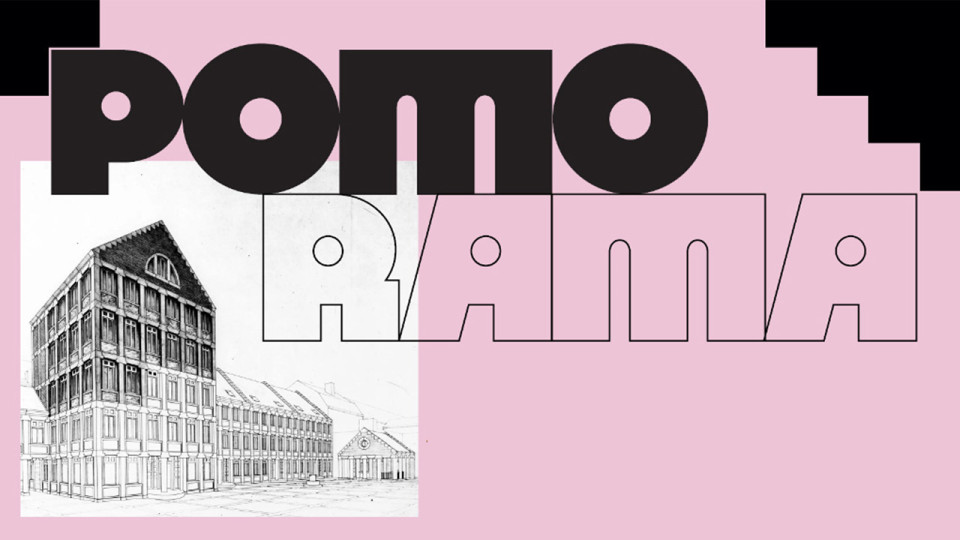
- 2nd image: Jeanne & Charles Vandenhove Foundation – Cour Saint-Antoine