Louis Leloup, a master glassmaker who made crystal dance
Louis Leloup (Seraing, 17 January 1929–12 August 2025)
A master glassmaker who made crystal dance
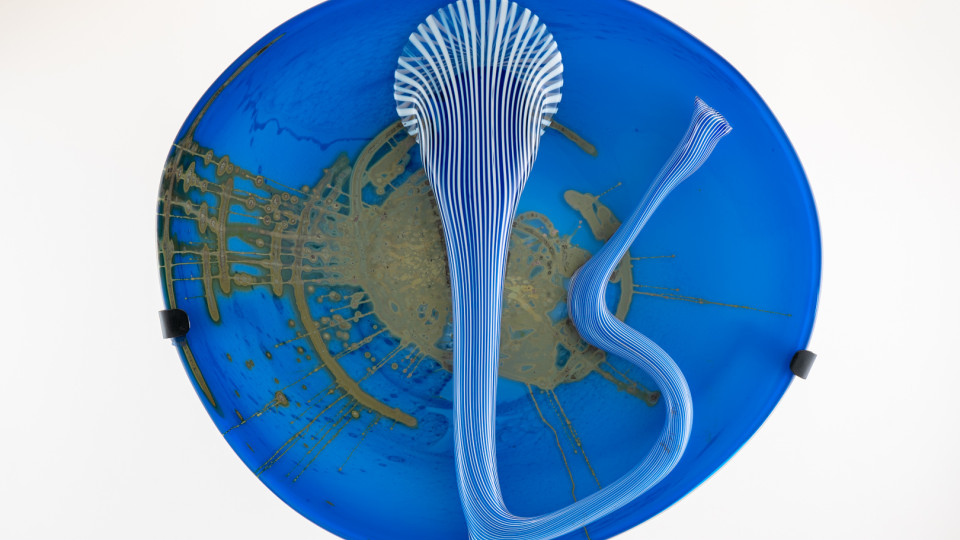
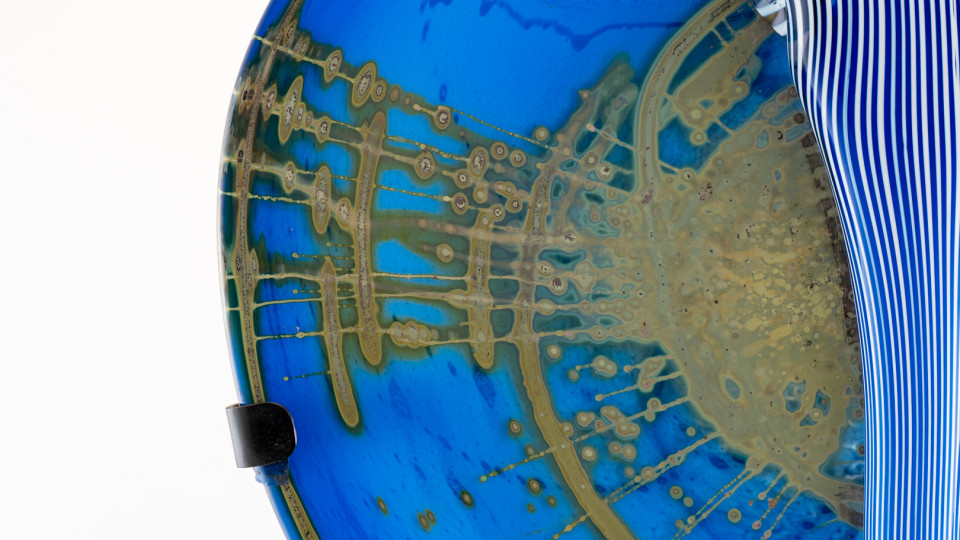
Louis Leloup, Méduse, 1982
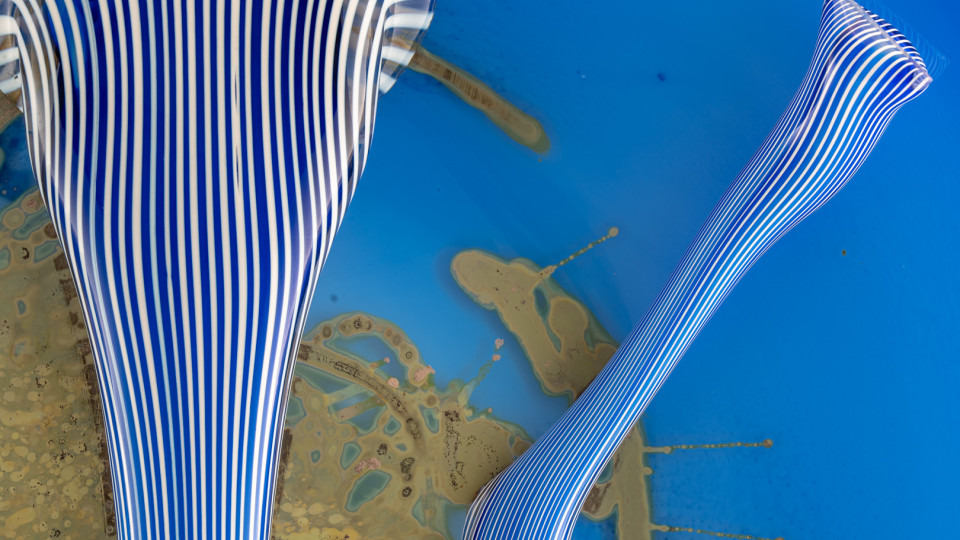
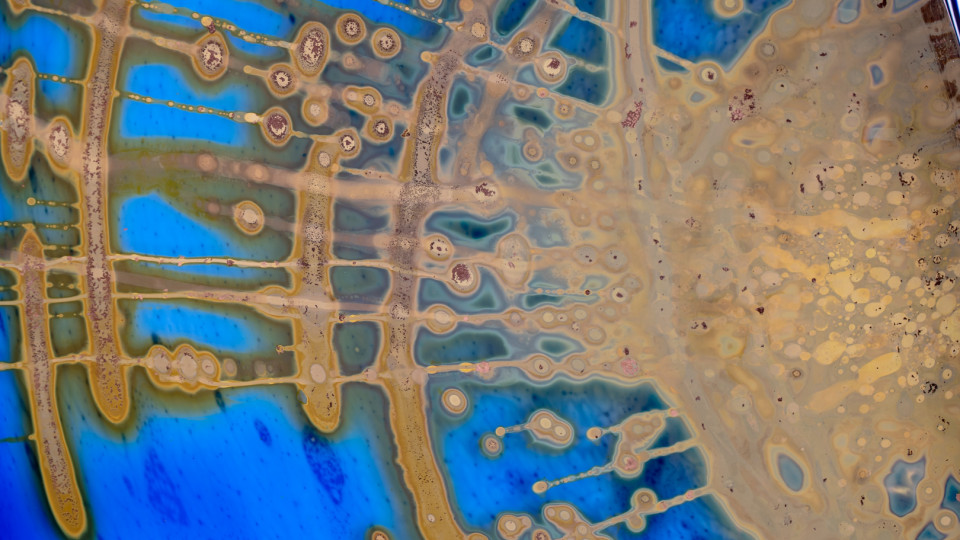
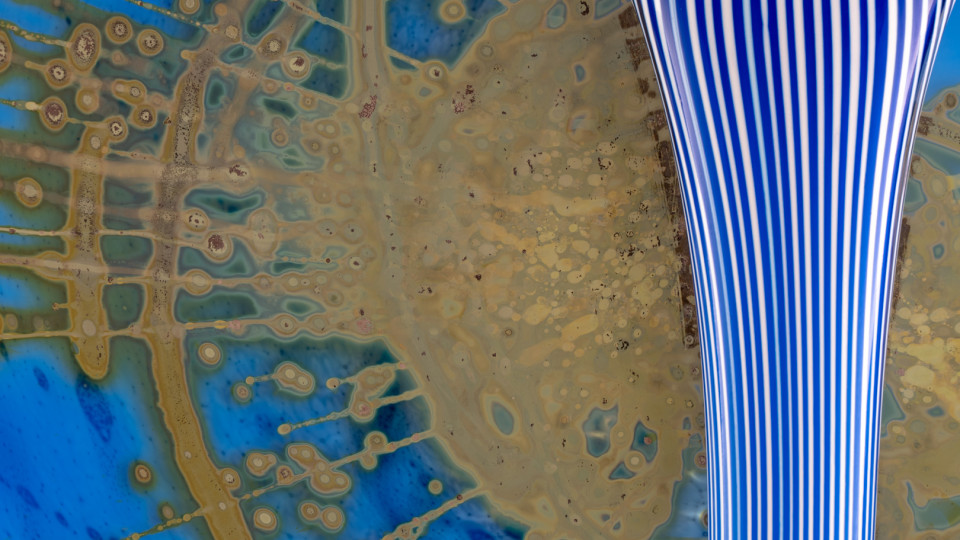
Metal base. Top adorned with golden metal oxides, sprayed in a beam using compressed air. Filigree cord widening to form the stylised umbrella-like shape of the sea creature.
Dimensions: 64 cm H x 48 cm W
Inv. No.: 82/141
Louis Leloup was one of the most creative and internationally renowned contemporary Belgian glassmakers, such was his exceptional mastery of hot-worked crystal. His sculptures, combining intricate forms and vibrant colours, reflect his technical and aesthetic boldness. This summer, the Grand Curtius is paying tribute to him through one of his works, *Medusa*.
A passion for crystal
An opera singer? Or a glassmaker? Louis Leloup chose to join the Cristalleries du Val Saint-Lambert in 1947. There he began his apprenticeship and developed a genuine ‘feel for glass’, coupled with a particular talent for shaping crystal, a process requiring both precision and speed.
He also took drawing classes and worked in the design department led by Charles Graffart (1893–1967), an engraver and designer, and later by René Delvenne (1902–1972), a designer.
In 1957, he was promoted to workshop foreman, managing a team of 10 glassmakers. His expertise enabled him to contribute to the creation of unique pieces presented by Le Val at the 1958 Brussels World’s Fair.
These included a 70 kg tall floor lamp and a coffee table with a central leg, both made from hot-formed crystal. It was also during this period that he experimented with multi-rod glassblowing and deepened his knowledge of metal oxides whilst undertaking training in ceramics.
In 1970, as the American Studio Glass* movement crossed the Atlantic, Leloup collaborated with the English designer Samuel Herman (1936–2020) to produce, at Le Val, the Eldorado series in crystal enriched with various oxides. Leloup’s signature (LL) appears alongside Herman’s on several vases. Various examples are held in the Museum’s collection.
*Studio Glass: originating in the 1950s in the United States, the movement promotes glassmaking as a free and artistic expression within independent studios. Harvey Littleton (1922–2013) is regarded as its founder, through his theoretical work and his creative and educational activities.
Tired of mass production, Leloup left the crystal factory in 1971 to set up his own studio in Seraing. His active participation in the symposium ‘Glassmaking: Art or Craft?’, organised by glass artists in Zurich in 1972, and the exhibition ‘The Art of Glass in the Common Market Countries’, held in Brussels in 1974, marked the start of his new career. Invitations to Belgian and international exhibitions followed in quick succession.
From 1979 onwards, Leloup combined traditional techniques with innovative experiments: an acid bath giving the crystal a satin finish was combined with the inclusion of gold or silver; the introduction of millefiori, sometimes on a large scale, or filigree swirls within the plastic density of colourless crystal resulted in distinctive compositions.
In the studio, he can count on the help of his wife, Méry, who also blows glass and creates small-scale works.
Museum recognition
Following his success in Europe, his rise to prominence on the Asian continent began in 1989–1990, during exhibitions in Tokyo and at the Fine Arts Museum in Taipei (Taiwan): thousands of visitors discovered Leloup’s work and, in 1997, the Japanese designer Shiro Ohtani dedicated a museum to him in Tokyo, attached to a school where his techniques are taught to international students. Whilst Leloup’s works can be seen in numerous international museums, the Grand Curtius can pride itself on housing around twenty of them, including several remarkable sculptures: Horizon (c. 1978), Regards (1979), Rose des sables (1986/87), Méduse (1982), Algue bleue (1982).
Isabelle Verhoeven
Curator of the Glass Department at the Grand Curtius
Exhibition location
The objects are on display in the ‘Object of the Month’ showcase. Entrance hall of the Grand Curtius Museum in Liège.
Photo copyright: City of Liège – Grand Curtius